Who the main Hindu gods and goddesses are
Most introductions to Hinduism begin with a number, and the number is misleading. Tradition speaks of 330 million devas and devis — divine beings — yet the same texts insist there is one reality behind them. That reality is usually called Brahman: without form, without limit, and not a person in the way a deity is a person. What a worshipper meets in a temple is Brahman approached through a form that a human being can actually hold in attention.
This is why Hindu tradition has so many deities without being, in its own self-description, polytheistic in the flat sense. The forms are real, and they are also doorways. A useful way to read the pantheon is therefore not as a ranked list but as a set of families, functions and relationships.
The most common organisation groups the divine in three ways.
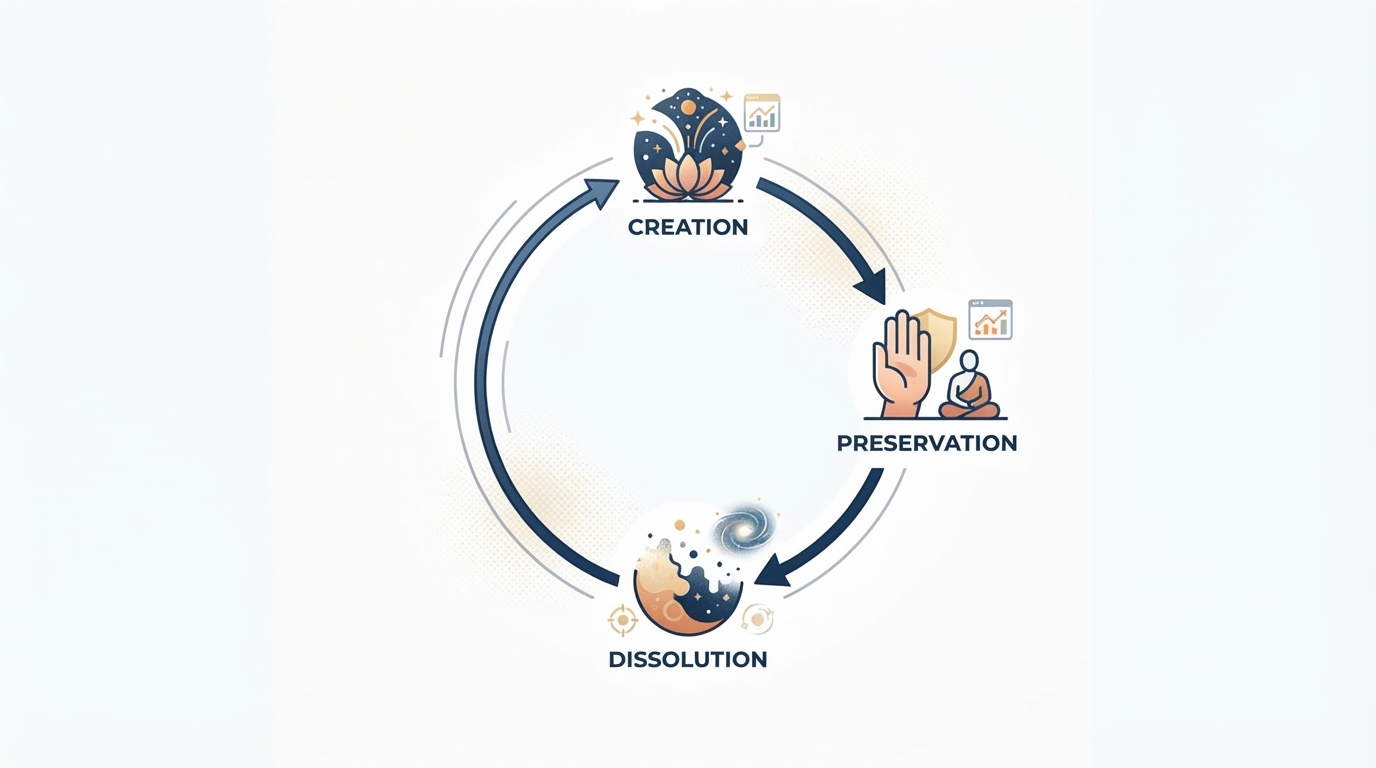
The Trimurti. Brahma, Vishnu and Shiva personify three cosmic functions: creation, preservation, and dissolution that makes the next cycle possible. These three are treated together in classical sources and in popular explanation, though — as with most things in Hinduism — individual traditions weight them very differently.
The goddess traditions. The Hindu goddess is not an appendix to the male gods. Lakshmi, Saraswati, Parvati, Durga and Kali carry their own theology, their own festivals and, in the Shakta traditions, supreme authority. Where the Trimurti maps three functions, the goddess traditions map the energy without which no function can operate at all.
The widely worshipped deities. Ganesha, Hanuman, Krishna and Rama are among the most loved figures in everyday practice, and each has a defined relationship to the larger structure: Ganesha and Kartikeya are sons of Shiva and Parvati, Hanuman serves Rama, and Krishna and Rama are avatars of Vishnu.
Around these sit countless regional and family deities — Mariamman in Tamil country, Khandoba in Maharashtra, family deities kept in household shrines — who are not lesser in the eyes of their devotees. The pantheon is organised, but it is organised like a living family, not like an org chart.
Brahma, Vishnu and Shiva: three functions in one cycle
Brahma creates, Vishnu preserves, and Shiva dissolves so that creation can begin again. Reading them as three separate gods with three separate jobs misses the point; the functions only make sense as a cycle, and the cycle has no beginning.
Deity | Function | Consort | Typical symbols | How the role is understood |
|---|---|---|---|---|
Brahma | Creation, the forming of worlds | Saraswati, goddess of knowledge and speech | Four faces, a lotus, the Vedas | Creation as an act of knowledge: the world is shaped by a knowable order |
Vishnu | Preservation of dharma and cosmic order | Lakshmi, goddess of prosperity | Discus, conch, resting on the serpent Shesha | Preservation is active: Vishnu intervenes, returns in form, restores balance |
Shiva | Dissolution and transformation | Parvati, and through her Durga and Kali | Trident, drum, crescent moon, the dance of Nataraja | Dissolution is not failure; it is the necessary clearing that allows renewal |
The comparison is worth stating plainly, because it corrects a common assumption. These are not rivals competing for power. Brahma's creation without Vishnu's maintenance would collapse, and Vishnu's maintenance without Shiva's dissolution would freeze into stagnation. The three roles describe one continuous process, which is why they are often shown together and why a single deity can be praised as all three.
Traditions differ on emphasis. Vaishnava theology holds Vishnu — with his avatars — to be the supreme source. Shaiva theology holds Shiva to be the ultimate reality, with the other functions emanating from him. The Trimurti framework is a shared grammar across those differences, not a ruling that abolishes them.
Brahma: the creator who is rarely worshipped
Brahma's role is the most structural and the least devotional. He is described as shaping the worlds, ordering them by knowledge, and setting the conditions in which everything else unfolds. His consort Saraswati is the goddess of learning, music and speech, and the pairing makes a claim worth pausing on: in this tradition, creation is closer to an act of knowing than to an act of force.
Yet temple worship of Brahma is remarkably rare, which puzzles newcomers who expect the creator to be the most honoured figure. Explanations vary, and it is honest to say that no single answer is universally accepted: one common account holds that his task belongs to the beginning of a cycle and is essentially complete; another points to pilgrimage geography, where the few surviving Brahma temples are exceptions. Either way, his small devotional footprint is not evidence of demotion — it reflects where the tradition places its attention.
Vishnu: the preserver and his avatars
Vishnu holds the order of things together. Where Brahma's work is a beginning, Vishnu's is an ongoing responsibility — dharma has to be maintained, not merely established, and the tradition describes him returning in form whenever that order is threatened.
Two of those returns matter more than any others for understanding popular Hinduism.
Rama is associated with righteousness, duty and honour. He is the central figure of the Ramayana, and the way he is worshipped stresses proper conduct under pressure: doing the right thing when the right thing is costly. His name anchors household practice across northern India and beyond.
Krishna is associated with divine love, compassion and wisdom, and he is the teacher of the Bhagavad Gita. Where Rama's devotees emphasise virtue, Krishna's emphasise intimacy — the idea that the divine can be approached through affection, play and friendship rather than only through duty.
Both are widely worshipped avatars of the same Vishnu, and neither is a reduction of the other. The distinction is useful because it explains a pattern readers notice quickly: two temples can be dedicated to what looks like one god and feel completely different.
The broader lists of avatars — usually ten, sometimes more, sometimes fewer — include forms such as Narasimha, Vamana and Parashurama, along with a future Kalki. Traditions count and order them differently, and some regional lists treat a beloved local deity as an avatar as well. What holds the idea together is the underlying claim: the divine does not stay at a distance, but arrives in the shape the moment requires.
Shiva: dissolution as transformation
Shiva is the deity most often misunderstood by readers encountering Hindu art for the first time. A figure who dissolves worlds, wears ashes, dances in a cremation ground and destroys — the description sounds like a god of death. In practice, Shiva is one of the most beloved figures in the tradition, and the reason is in the doctrine: destruction here is not annihilation but clearing.
The image of Nataraja makes the point in a single form. Shiva dances inside a ring of fire, one hand holding a drum of creation, another a flame, a raised palm signalling "do not fear", and a foot planted on a dwarf representing ignorance. Creation and dissolution appear in the same posture, as one gesture. The famous Shiva lingam, too, is generally read as a form without a fixed outline — a marker of the formless reality that any image is pointing to.
Shiva's household is itself a map of the pantheon. His consort Parvati is the goddess in her gentle aspect; in her fierce aspects she appears as Durga and Kali. Their sons are Ganesha, the elephant-headed remover of obstacles, and Kartikeya, associated with valor and strategy. So the two most widely approached deities for new beginnings and for courage are, in the family structure, the children of the transformer and the goddess.
The goddess traditions
The goddess is where the pantheon's arrangement stops looking like a hierarchy at all. In Shakta traditions, the Devi — the Goddess — is not a consort or a supporting figure but the supreme reality, and the male gods derive their power from her. The shared concept is Shakti: energy, capacity, the power to act. Without Shakti, a deity is potential without operation.
Three goddesses are met most often in explanation, and they are best read together.
Lakshmi is associated with prosperity and good fortune, and she is the consort of Vishnu — which is to say that the order Vishnu maintains appears in the world as abundance. Saraswati is associated with knowledge, music and the arts, and she is the consort of Brahma — creation appearing as learning. Parvati is associated with love, devotion and fertility, and she is the consort of Shiva — transformation appearing as relationship.
These are gentle forms. The same goddess is also known in forms a reader should not confuse with them. As Durga, she is the protective warrior who meets a force that cannot be reasoned with. As Kali, she is time itself, fierce and unbounded. The common mistake is to read these as different goddesses with different personalities. The tradition usually treats them as the same presence in different modes, and the mode depends on what the moment requires.
Regional traditions add their own supreme forms — Meenakshi in Madurai, Kamakhya in Assam — and for their devotees they are not variations on a central figure but the central figure, locally.
Avatars and forms: how one deity becomes many
Two ideas do most of the work of holding all of this together, and both are easy to state in plain language.
An avatar is a descent: the divine taking form in the world for a purpose. Vishnu's avatars are the most discussed set, but the idea travels — a goddess can have avatars, a regional deity can be understood as one.
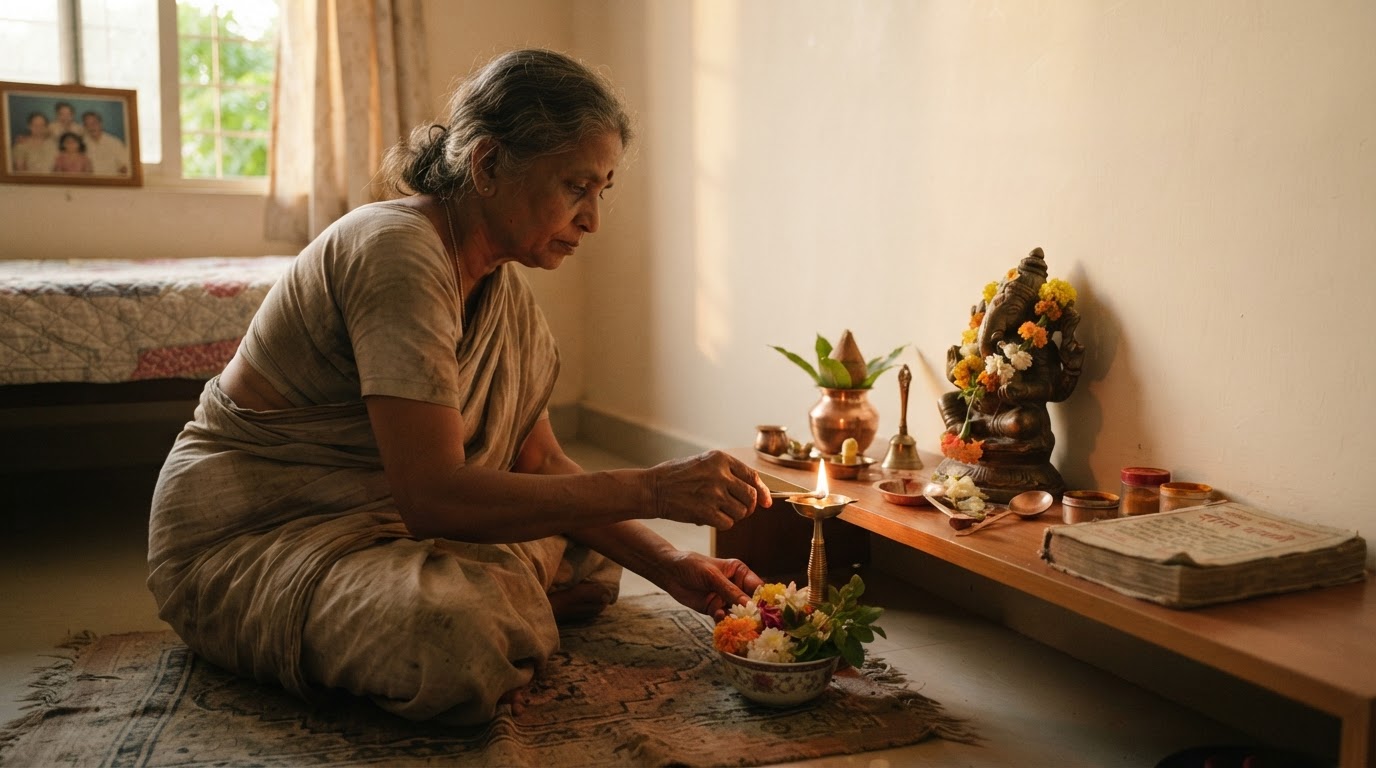
A murti is the made image in a temple or home shrine. It is not a portrait of a god, and it is not treated as an idol in the dismissive sense. It is the form through which relationship becomes possible, and its purpose is to be a meeting point rather than a likeness.
Traditions differ on how literally to read these ideas. Advaita philosophy reads the many forms as appearances of one reality. Dualist schools hold a real and enduring distinction between the soul and the divine. Devotional traditions may care very little about the metaphysics and a great deal about the relationship, and that is not a shallower position — the relationship is the point. A good explanation names the disagreement instead of smoothing it away.
A common mistake: the pantheon is not a power ranking
The most frequent error in popular treatments is turning the pantheon into a leaderboard. Search results promise "the most powerful Hindu gods" and rank Brahma, Vishnu and Shiva against Lakshmi and Ganesha. This flattens the tradition into something it does not claim to be, and it hides the relationships that make the pantheon intelligible.
A second error follows from the first: assuming every deity answers the same question. Lakshmi is not asked what Shiva is asked. A devotee approaching Ganesha at the start of an undertaking and a devotee approaching Kali in a crisis are not shopping between options; they are addressing different situations through different forms.
A useful rule for reading any list of Hindu deities is to ask three things: what function does this figure carry, what relationship places them in the family, and which tradition is speaking. Lists that answer none of these are decoration.
Where to keep reading and listening
Readers who want to go past an overview have natural next steps. The deity-specific traditions reward deeper study: Shaiva material on Shiva's forms, Vaishnava material on the avatars, and Shakta material on the goddess, each with its own vocabulary.
For that stage, the Articles section of KAILASA's Nithyananda TV carries plain-language explainers built around single concepts — tantra, chakras, dharma — each dated, with a one-line thesis and the teaching attributed to The SPH. That format is useful precisely for the step this overview cannot take: it treats one idea at a time, in the language of the tradition, without requiring prior familiarity. It is a reasonable companion to this map, though any single platform reflects one lineage's reading rather than the whole of Hindu thought.
Questions readers ask first
Is there one Hindu god or many? Both answers are used, and the difference is usually about level. One reality, Brahman, without form; many forms through which that reality is approached. Which emphasis a text takes depends on whether it is doing philosophy or devotion.
Who is the most powerful Hindu god? The question does not have a stable answer in the tradition, because the figures are described as functions of one process rather than as competitors. Shaiva, Vaishnava and Shakta sources each identify their own deity as supreme, and each does so coherently.
Are Krishna and Rama separate gods? They are widely worshipped avatars of Vishnu, worshipped in their own right with their own temples, festivals and theology. Calling them avatars of Vishnu explains their place in the structure; it does not reduce the devotion they receive.
Why are there so many forms of the goddess? Because the forms answer different moments. The same presence is met as prosperity, as learning, as love, as protection and as time. The gentle and fierce forms are not competing personalities but one energy in different conditions.
Where do Ganesha and Hanuman fit? Ganesha is the son of Shiva and Parvati, the remover of obstacles approached at beginnings. Hanuman is the devoted servant of Rama, associated with strength and service. Both hold their place through relationship rather than rank.