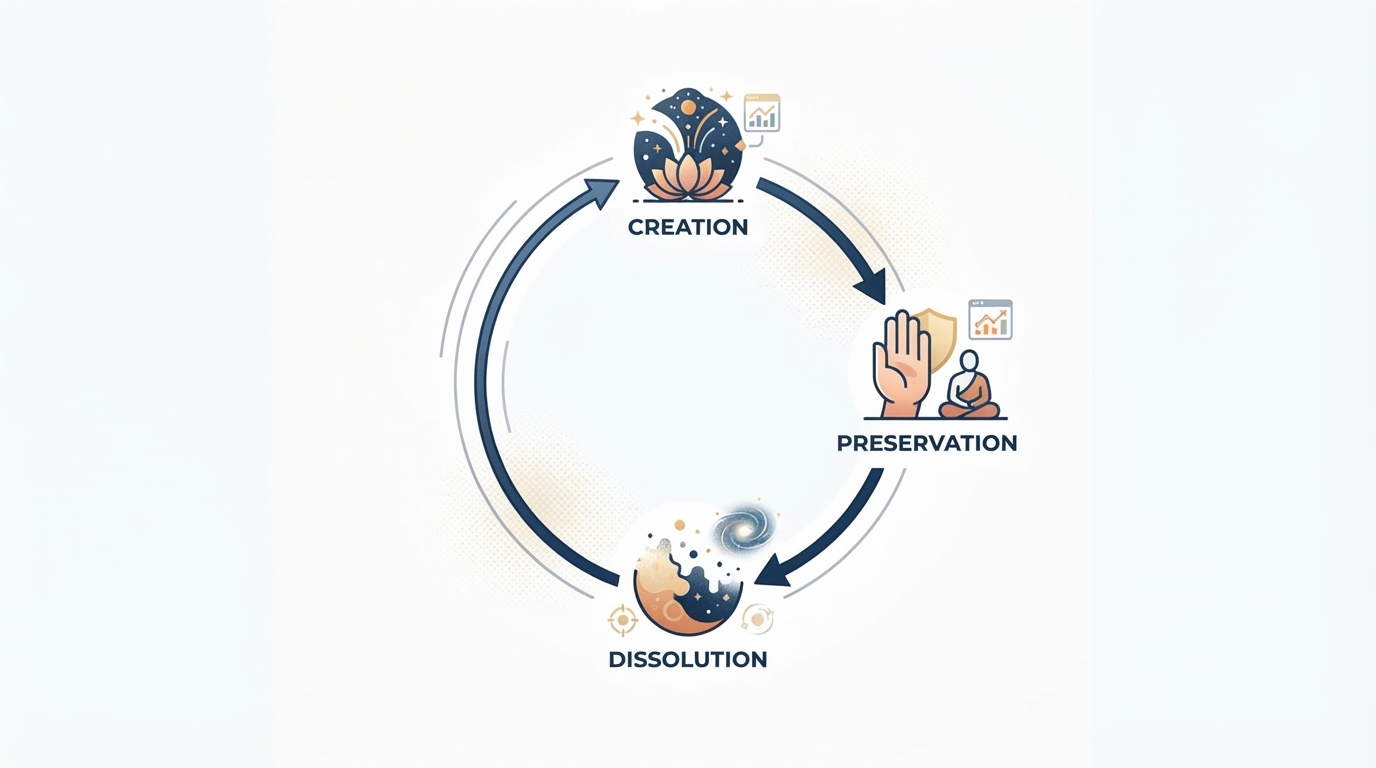
What people mean by "spiritual finger"
The phrase is used in three quite different senses, and mixing them up is the main reason the material online feels contradictory.
The first is the gesture sense: the finger as the instrument of sacred gesture. Mudras seal the thumb and fingers into shapes; priests bless with the index and middle finger raised; tilak is applied with a specific digit; a finger is lifted in testimony and in prayer. Here the finger matters because of what it does.
The five-finger map, and why the tables disagree
Most traditions that assign meanings to fingers work from two separate systems that are often printed side by side as if they were one.
One is a tantric and ayurvedic element scheme, in which the digits correspond to the five gross elements. The other is the planetary scheme inherited from Western and Indian palmistry, where each finger belongs to a planet. The two schemes overlap in spirit but not in detail, which is why a single finger can be called both "fire" and "Venus" depending on which book you opened.
A widely reproduced version looks like this:
Finger | Element (tantric mapping) | Planet (palmistry) | Commonly read as |
|---|---|---|---|
Thumb | Fire (agni) | Venus | Will, the sense of self, the capacity to act |
Index | Air (vayu) | Jupiter | Direction, teaching, authority, blessing |
Middle | Ether (akasha) | Saturn | Restraint, time, discipline, boundaries |
Ring | Earth (prithvi) | Sun / Apollo | Steadiness, vows, radiance, reputation |
Little | Water (jala) | Mercury | Speech, exchange, learning, quickness |
Treat that table as one arrangement among several, not as doctrine. Different lineages swap elements, and palmistry traditions assign the thumb to Mars or to the self rather than to Venus. The diagrams are useful as a vocabulary, not as a physics of the hand.
Finger by finger
Thumb — will and the fire of the self
The thumb is the digit that makes a human hand able to grip, and the traditions that personify the hand tend to give it the role of will. In the element scheme it is fire: the heat that digests, converts, and drives. In palmistry it is associated with vitality and with the strength or weakness of resolve.
Practically, the thumb is also the keystone of nearly every hand gesture. Without it, the index finger cannot be sealed into a circle, the palm cannot form a cup, and the hand cannot be bound into a fist. That structural fact is probably why so many systems place the self at the thumb.
Index finger — direction and teaching
The index finger points. That single mechanical fact underlies almost all of its symbolism: the teacher indicating a truth, the witness identifying a culprit, the priest indicating the divine, the caller drawing attention to the moon rather than to the finger.
In palmistry it belongs to Jupiter, the planet of authority and guidance, which is why a long, straight index finger is often read as a sign of confidence and of a teaching temperament. In the element scheme it is air — movement, transmission, the medium through which instruction travels.
There is a real cultural caution here. In much of Europe and North America, pointing at a person is rude; in parts of Asia and Africa, pointing with the index finger at people or sacred images is avoided in favour of an open hand. The same digit that signifies teaching in one setting signals accusation in another.
Middle finger — restraint and time
The middle finger is the longest, and the systems that assign qualities by position read that length as reach and responsibility. In the element scheme it is ether, the subtlest of the five, associated with space and with the discipline required to hold a practice over years. In palmistry it is Saturn: boundaries, patience, limitation, the slow lessons.
It also carries the heaviest cultural contradiction of any digit. The same gesture that means "restraint" in a symbolic table is a blunt insult across most of the world. That gap is a useful reminder that finger meanings are always local conventions layered on top of anatomy, never properties of the bone itself.
Ring finger — vows, steadiness, and the marking finger
The ring finger has two strong associations that reinforce each other.
The first is the vow. Roman practice set the wedding ring here on the belief that a nerve ran directly from this finger to the heart — anatomically wrong, but symbolically durable, and the reason the digit is called the ring finger in English at all. A ring on that finger is a public statement of a commitment that is meant to outlast mood.
In the element scheme it is earth, the most stable of the five, and in palmistry it is the Sun, the planet of visibility and honour. That combination — earth and sun — produces the reading most traditions converge on: quiet steadiness that others can see.
The second association is ritual application. In many Vaishnava and Smarta households the tilak or vibhuti is applied with the ring finger rather than the index, precisely because the ring finger stands for calm and balance rather than for pointing or asserting. The gesture is deliberately understated: the mark is placed, not imposed.
Modern teachers have pushed this idea further, describing the ring finger in energetic rather than social terms. Whether or not you accept that framing, the ritual evidence is consistent: when a tradition wants a gesture of steadiness, it reaches for this digit.
Little finger — speech and exchange
The little finger is the one used for fine distinctions: counting subdivisions of a rhythmic cycle, pointing to a word while reading, lifting a cup with the hand in an elegant grip. In the element scheme it is water, and in palmistry it is Mercury — the planet of speech, commerce, and cleverness.
That pairing explains the double reading the digit usually receives: expressive and adaptable on one side, restless and quick to talk on the other. In devotional settings it is often the finger that carries the smallest, most precise movements — a flick of the fingertips in a bhajan, the counting of a mantra on the joints rather than the tips.
How the fingers are actually used in ritual
Symbolism is easiest to trust when you can point to a practice, not just a table.
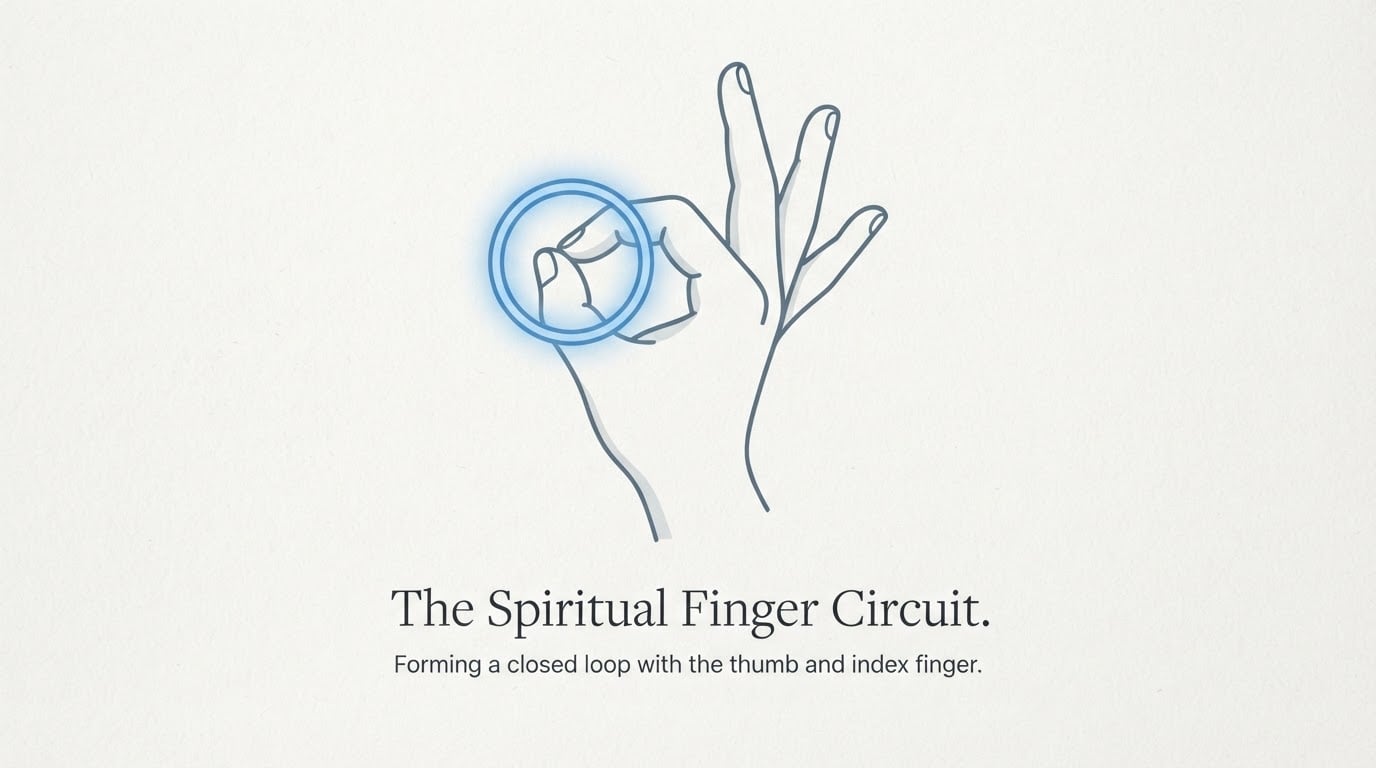
Mudras. The most widely taught hand seals are built on finger pairings. Chin mudra and jnana mudra join the tip of the thumb and index finger into a closed circle with the other three fingers extended — a shape read as the individual self meeting the universal. Prana mudra joins the thumb with the ring and little fingers, leaving the index and middle fingers extended. Apana mudra joins the thumb with the middle and ring fingers. Dhyana mudra stacks the hands in the lap with thumbs lightly touching. In each case the meaning is carried by the closed or open circuit the fingers create.
Tilak and vibhuti. The marking of the forehead is a daily act in many Hindu households, and the choice of finger is part of the act: the ring finger for calm, the index for assertion, the thumb for the grosser mark. The material differs by lineage — sandalwood paste, sacred ash, vermilion — but the logic of choosing a finger is shared.
Counting. Indian classical music counts rhythmic cycles on the joints and segments of the fingers, so that a whole tala lives in one hand. Japanese counting opens the palm and folds fingers down one at a time, while other cultures count on the thumb against the fingers. Anyone who has tried to count along with a different tradition knows how deeply the habit is wired.
The nine worship mudras, digit by digit
The core of the collection is a sequence from the Raurava Agama, in the section titled Mudra Lakshanam. On Hand Mudras lists the nine to be shown in order during Shiva worship — namaskara, dhvaja, sasakarnika, mukula, padma, avahana, nishthura, kalakanthi, and linga — together with what each one is for: salutation, then meditation, then the inner link with the deity, then offering the seat, then invoking, then stabilising the presence and warding off obstacles, then the consummation of the worship, then identity between Shiva and the devotee.
Read the individual pages and the fingers are specified with legal precision:
- Namaskara mudra — the palms of both hands pressed together in front of the heart. No digit is singled out at all; the whole hand is the unit.
- Dhvaja mudra — the left hand held at the neck, touched with the forefinger (tarjani), while the right thumb is kept raised upright. This is the mudra held to begin meditation.
- Sasakarnika mudra — both wrists pressed together, thumb and forefinger of each hand joined, hands raised. Its stated purpose is the "intimate link with the Deity".
- Avahana mudra — hands cupped into a hollow at the chest, thumbs bent so they touch the palms, all the remaining fingers held close together. Shown while offering the deity a seat.
- Nishthura mudra — thumbs bent and pressed inside closed fists, the gesture turned towards the deity, to stabilise the presence in the image being worshipped.
- Kalakanthi mudra — both thumbs bent downward and facing each other. The page carries the verse and its transliteration but no full translation, which is itself worth noticing: the archive is a translation project still in progress.
- Linga mudra — the right thumb raised upright, the right hand clenched, and that fist placed inside the left hand so the left fingers cover it. The verse calls it mahavirya, of great vigour, and assigns it to the worship of Shiva.
What is striking, if you have just read the element and planet tables, is how little symbolism any of this carries. Nothing in these Raurava Agama verses says the ring finger is earth or the little finger is Mercury. The thumb is bent, raised, or pressed; the instructions are about position and sequence, and the meaning is carried by which mudra is being performed rather than by which finger is "yours".
The eN Kriya: five fingers, five senses
The most explicit digit-by-digit teaching in the archive comes from the eN Kriya instructions Nithyananda gave in early 2011, preserved as dated satsang transcripts. The fourth and main step is a form of shambhavi mudra:
"Put your thumb in the ears, the index finger and middle finger on the eyes, ring finger on the nose, little finger on the lip. It is called shambhavi mudra. Close all the five senses, block the nostrils."
The same instruction recurs in at least three separate discourses that spring — 20 February 2011, 27 February 2011, and 6 March 2011 — which makes it a teaching rather than a passing remark. In the March discourse he addresses directly the naming confusion this article has been circling:
"Somebody asked Me a question. 'Swamiji the mudra which we are doing is described as some other name in some other books.' Don't bother about all that. Just do this mudra."
So the naming disputes and the symbolic tables are secondary. The operative content is the assignment of digits to sense organs — thumb to hearing, index and middle to sight, ring to smell, little finger to touch at the lips — so that one hand closes all five doors at once. Here the fingers are not a map of your character; they are a switch panel.
Why the archive frames mudras as seals rather than readings
The archive's introductory page on mudras gives the doctrinal reason. Quoting the Shiva Samhita and the Hatha Yoga Pradipika, it frames mudra practice as the means of awakening the goddess "asleep at the entrance of brahma-dvara" — kundalini, in the hatha vocabulary — and lists the ten "best" mudras of that corpus: mahamudra, mahabandha, mahavedha, khechari, jalandhara, mulabandha, viparitakarani, uddiyana, vajroni, and shaktichalana. A yogi who knows any one of them, the verse says, becomes a siddha.
Notice the shift in category. A palmistry table tells you what a finger is; this material tells you what a hand does, and treats the doing as the mechanism. Finger positions are prescribed because they seal or redirect prana, not because they reveal temperament.
One place where a finger does carry biography
There is an exception, and it is a story rather than a table. In a 23 December 2024 discourse on authenticity, the little finger becomes the emblem of a promise. Retelling the Narasimha story, Nithyananda describes the child Prahlada lifting a little finger to show where Vishnu is:
"The story goes when you are authentic, just if you move your little finger Parandhama moves. Paramashiva rushes to make your sankalpa into reality."
That is not a system of correspondences and it is not a personality reading. It is a moral image — the smallest digit standing for the smallest gesture a sincere intention needs — and it is the closest the archive comes to the "spiritual finger" of the popular phrase.
Three adjustments to the table above
- Most traditions use fingers as instruments before they use them as signs. If you want the older, better-attested layer, the mudra specifications predate the personality charts.
- Where a tradition does assign meanings, the assignment usually serves practice. The ring finger is read as "calm" partly because tilak is applied with it; the thumb is read as "the self" partly because it is the digit that makes a grip possible.
- The archive is a translating, incomplete corpus — a page with a verse and no translation, nine mudras described in sequence but not illustrated. Treat it as a source to check against ritual practice, not as a finished dictionary.
Right hand and left hand
The two hands are rarely treated as equals. In South Asian convention the right hand gives, offers, and blesses, while the left receives, supports, and handles what is considered impure. That is why offerings are made with the right hand and why the left hand supports the right wrist rather than performing the act.
Tantric practice complicates this. Some left-hand paths deliberately invert the ordinary purity rules as a form of discipline, which is exactly why they are controversial within the traditions that produced them.
In palmistry the convention varies. A common Western rule reads the non-dominant hand as inherited potential and the dominant hand as what has actually been made of it; other schools treat the left hand as the unconscious record and the right as conscious action. If you are reading about your own hands, check which convention the source is using before drawing conclusions.
A short practice, and how to know it worked
If you want to work with finger symbolism rather than just read about it, keep it small and testable.
- Choose one finger that matches the quality you want more of — the thumb for follow-through, the ring finger for steadiness, the little finger for patience in conversation.
- Set a two-minute window once a day. Sit with the palms open on the knees, join that finger with the thumb, and let the breath be ordinary.
- Note one sentence afterwards: what changed in the body, what changed in the mood. One sentence, not a journal entry.
- Review after seven days. The completion standard is seven written sentences and one clear answer to the question: did this gesture do anything for me?
The point is not to accumulate techniques. It is to find out whether a symbolic gesture reliably changes your state, or whether it is only a pleasant ritual. Either answer is useful, and only your own seven days can supply it.
Where finger symbolism breaks down
Three honest limits are worth carrying with you.
The systems contradict each other. Element schemes, planetary schemes, and local folk readings disagree about which finger rules what, and none of them is derived from the others. When two sources conflict, they are not making competing claims about one hidden fact; they are using two different vocabularies.
Symbolism is not diagnosis. Nothing in finger symbolism can tell you whether you have a medical condition, and no finger reading should delay care. Persistent tingling, numbness, weakness, tremor, or pain in a finger is usually mechanical or neurological — a nerve compression, a joint problem, a circulation issue — and belongs with a clinician, not with a chart.
Cultural meaning is not universal. The same digit that means teaching in one tradition is an insult in another, and a gesture that reads as devotion in one community reads as superstition in the next. Treat every table as a regional dialect, not as a global dictionary.
Common questions
Is the ring finger the most spiritual finger?
It is the most ritual finger in a lot of traditions — vows, marriage, tilak, blessing — and it is the digit most often singled out in modern teaching as a kind of control point for the whole hand. But "most spiritual" is not a category the classical sources rank. The thumb, as the seat of will, has an equally strong claim, and the index finger has the longest record as the finger of teaching.
Which finger should be used for tilak?
Practice varies by lineage and household. The ring finger is common where calm and balance are the intended meaning; the index finger appears where the mark is more declarative; the thumb is used in some traditions for a broader, heavier application. If you are learning within a specific tradition, follow that tradition rather than an online chart.
What does a tingling finger mean spiritually?
Folk interpretation offers many answers — energy moving, a message arriving, a sign of an unresolved intention. None of them is verifiable, and none can rule out a physical cause. Treat the folk reading as poetry if it helps you, and treat repeated tingling as information about your nerves and posture. If it persists, get it examined.
Do different religions agree on what fingers mean?
No, and they are not trying to. Hindu, Buddhist, Christian, Islamic, and Jewish hand practices each developed their own gestures for their own reasons, and where they coincide — a raised index finger, an open palm, the joining of thumb and forefinger — the similarity is often coincidence of anatomy rather than shared doctrine.
Is left-handed finger symbolism different?
In traditions that reserve the right hand for giving and the left for receiving, yes: a left-handed person is following a different set of conventions from birth, and many traditions quietly accommodate that in practice. In palmistry, the difference is usually handled by which hand is read for potential and which for action, not by reversing the meanings.
Where do the five elements and the five fingers come from together?
The pairing is old and appears across ayurvedic, tantric, and yogic literature, but it survives in dozens of local variants rather than one canonical version. That is why the most reliable thing you can say about it is structural: five digits, five elements, a hand that can act and a body that can be read as a small copy of the world.