Who Is Kartikeya and What Is He the God Of?
Kartikeya is the Hindu god of war, victory, and wisdom, and in the Puranic accounts he is the commander-in-chief of the celestial armies — the one the gods install as their general when no ordinary warrior can settle the contest. He is a son of Shiva and Parvati and is traditionally the brother of Ganesha, though tellings differ on which of the two brothers is the elder.
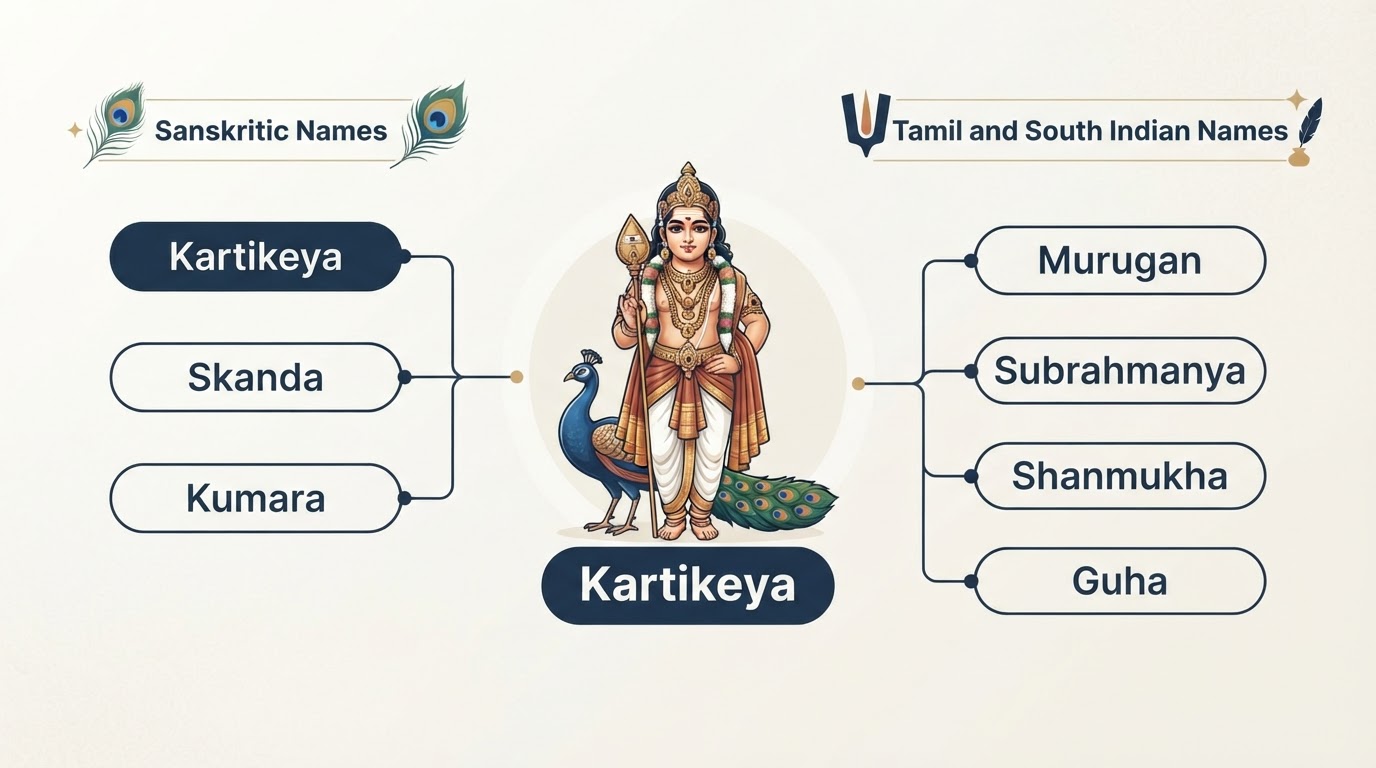
That short answer matters because most confusion about this deity is not about his power but about his name. A reader who searches for Kartikeya, Muruga, or Skanda is looking at one god seen from three directions: a Sanskritic, martial, Puranic framing; a Tamil, devotional, literary framing; and a classical epithet attached to both. The warrior role is the thread that holds the three together. He is young, he is armed, and he is entrusted with a fight that others cannot win.
One Deity, Many Names
The names are not aliases invented for convenience. Each carries a different emphasis, a different region of use, and a different century of literature behind it.
Name | Where it is most used | What the name emphasizes |
|---|---|---|
Kartikeya | Sanskrit and pan-Indian usage | His rearing by the Krittikas, the six stars of the Pleiades |
Murugan / Muruga | Tamil Nadu and the Tamil diaspora | The youthful, beautiful, honey-sweetened form central to Tamil devotion |
Skanda | Sanskrit texts, Puranas, Sri Lanka | The martial epithet familiar from the Skanda Purana |
Kumara | Sanskrit and classical Tamil | The eternal youth, the princely boy who never ages into a settled householder |
Subrahmanya | South India, especially Karnataka and Andhra | The auspicious, brahminical register of the same god |
Shanmukha | Pan-Indian devotional usage | The six-faced form, from his six foster mothers |
Guha | Sanskrit and Tamil literature | The hidden or cave-dwelling one, close to the heart rather than the battlefield |
Murugan and Muruga are the forms a Tamil speaker is most likely to use in prayer, in song, and in ordinary conversation. Kartikeya and Skanda dominate the Sanskrit corpus and the English-language summaries that draw on it. Subrahmanya, Shanmukha, and Guha belong to the same identity and appear constantly in temple names, devotional songs, and invocations.
Shiva and Parvati's Son: Family and the Origin Accounts
Every tradition agrees that Kartikeya is the son of Shiva and Parvati. The birth stories diverge after that agreement, and the divergence is worth stating plainly rather than smoothing over.
In one widely told Puranic sequence, Shiva's fiery energy is carried by Agni and cooled in the Ganga, then received by six Krittika maidens who nurse the child. Because six mothers raise him, he manifests six faces, and the name Shanmukha follows directly from that. In other tellings, Parvati's own maternal role is foregrounded, and the Krittikas are foster mothers rather than the primary source of the child. In Tamil tradition, Murugan is unambiguously the son of Shiva and Parvati, raised among the Krittikas, and the six-faced form is treated as an expression of his fullness rather than a by-product of a hand-off between guardians.
These are not competing claims about who the deity is. They are different accounts of how a divine child arrives in the world, told by different communities with different textual anchors. Treating one as the historically correct version and the others as corruptions flattens exactly the regional texture that makes the figure interesting. The family picture is stable: Shiva and Parvati as parents, Ganesha as brother, the Krittikas as the constellation-linked foster mothers whose number is inscribed in the iconography.
The Warrior Role: The Vel, the Demon, and the Six Faces
The warrior narrative is the reason Kartikeya exists in the Puranic imagination as a commander rather than a minor attendant. When the asura Surapadman — Tarakasura in many tellings — becomes unbeatable by ordinary means, the gods need a general born for that specific fight. Kartikeya is that general. He is given the vel, the spear, and in the Tamil reading the vel is not merely a weapon but a spear of divine knowledge, the sharp point that cuts through ignorance. After the battle, Surapadman's severed form becomes the peacock that carries the god and the rooster that stands on his banner, so the defeated adversary is folded into the victor's entourage rather than erased.
Iconography follows the story. Kartikeya is shown as a young man, often with six faces when the name Shanmukha is in play, holding the vel, mounted on a peacock, with a rooster on his flag. The youthfulness is deliberate and theologically loaded: he is the god who never becomes a householder, never settles, never loses the sharpness of the moment before a decision.
What Devotees Ask of Him
Devotees approach Kartikeya for courage, for victory in a contest that has become unavoidable, and for clarity when a choice has stalled. The vel gives the devotional vocabulary its shape. If the spear is knowledge, then the battle is as often internal as external — confusion, hesitation, a mind that will not settle — and the god's youthfulness reads as alertness rather than inexperience.
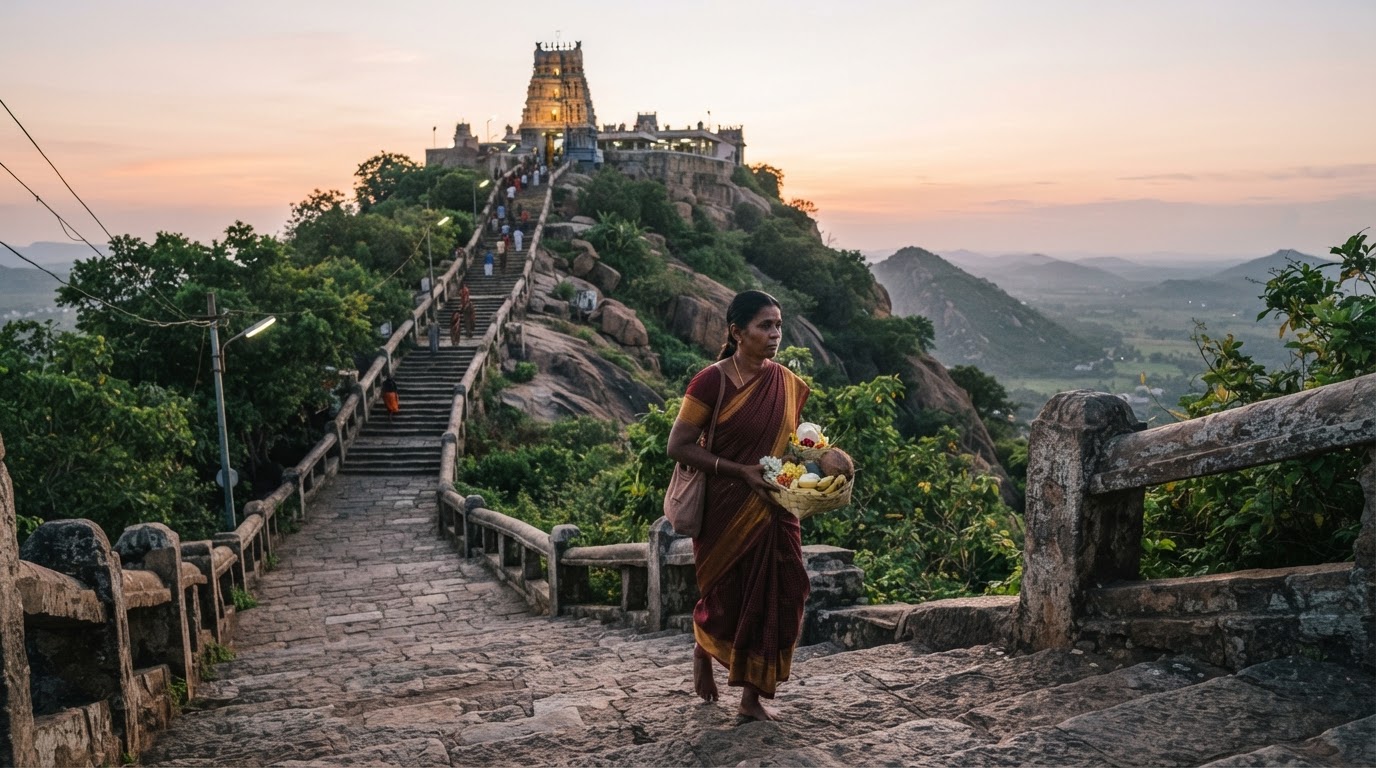
The Tamil devotional tradition adds warmth to that martial framing. Murugan is called Tamil Kadavul, the god of the Tamil language, and classical and medieval Tamil literature treats him as the patron of poetry, music, and eloquence. His six abodes, the Arupadai Veedu, anchor a geography of pilgrimage across the Tamil country, each shrine attached to a different phase of the story: Tirupparankunram, Tiruchendur, Palani, Swamimalai, Tiruttani, and Pazhamudircholai. Festivals such as Skanda Shashti and Thai Pusam give that devotion a public calendar, though the schedules and ritual details belong to a separate topic.
Why Muruga Is Central to Tamil Devotion
For Tamil devotees, Murugan is not a regional variant of a northern god. He is a tutelary deity in the full sense: a figure who stands for the community's language, its literary heritage, and its sense of itself across centuries and oceans.
That centrality shows up in literature before it shows up in temple architecture. The Sangam-era Tirumurugatrupadai is a guide to his shrines; the medieval Thiruppugazh of Arunagirinathar is a body of hymnody built almost entirely around his names and forms; the Kandha Shashti Kavasam and Kandhar Anubhuti belong to the same devotional stream. A god with that much poetry behind him is a god whose devotees expect intimacy, not distance.
The geography of that devotion is now global. Tamil communities in Sri Lanka revere Murugan at Kataragama; in Malaysia the Batu Caves shrine draws devotees from across the region; in Singapore, temple worship and Tamil-language hymn singing keep the same forms alive. For a diaspora devotee, Muruga is one of the few figures who travels without translation — the songs, the names, and the six abodes mean the same thing in Chennai, Jaffna, and Kuala Lumpur.
Common Misreadings Worth Correcting
Three mistakes recur in English-language summaries of this material, and each one costs the reader something.
The first is treating Muruga and Kartikeya as separate deities who happen to share a few features. They are one god under regional names, and the identification is old, explicit, and uncontested within the traditions themselves.
The second is flattening the birth narratives into a single authoritative version. The Puranic Krittika account and the Tamil emphasis on Parvati's motherhood are not rival truth claims to be adjudicated; they are different tellings, and the honest description attributes each to the stream it comes from.
The third is assuming that a war god is only about external combat. In the Tamil reading the vel is knowledge, and the fight is frequently the reader's own. Reading Kartikeya as a purely martial figure strips the devotional layer that makes him a figure of daily prayer rather than a mythic general.
The limitation that follows from all three: this is an overview of identity and devotional significance, not a ritual manual or a festival calendar, and the dating of specific text layers is a separate scholarly question that no short article should pretend to settle.
Quick Answers
Who is Kartikeya and what is he the god of? Kartikeya is the Hindu god of war, victory, and wisdom, and the commander-in-chief of the celestial armies. He is the son of Shiva and Parvati, and his warrior role follows directly from that identity: he is the general the gods require, born into the family that can supply one.
What are the other names for Kartikeya, Muruga, and Skanda? Murugan and Muruga are the Tamil forms, Skanda is the classical Sanskrit martial epithet, Kumara is the eternal youth, Subrahmanya is the auspicious southern register, Shanmukha refers to the six-faced form, and Guha is the hidden one of the cave and the heart. All name the same deity, and Murugan or Muruga is the form most used in South India and Tamil culture.
Why is Muruga especially important to Tamil devotees? He is a central tutelary and cultural deity for Tamil Nadu and for Tamil communities in Sri Lanka, Malaysia, and Singapore — the god of the language, the patron of its poetry and music, and the anchor of the six abodes. His importance is cultural as much as devotional, which is why the devotion survives migration so intact.
Read together, the names, the family accounts, and the warrior narrative describe one figure with an unusually wide range: a Puranic general, a Tamil poet's patron, and the young god a household calls on when it needs clarity. That range is the answer to the search that brought most readers here.